Showing posts with label Story. Show all posts

Friday, April 20, 2018

Week 13 Story: The Contest of Trickery

When the Sheriff of Nottingham set up a contest of archery, all of the outlaws of Sherwood Forest knew that Robin Hood would take the bait. It was most obviously a trap, and David of Doncaster confirmed this for them.

But if they could not convince their fearless leader to not attend the archery competition - and they could not, for he would call any who did so a coward - then perhaps there was another plan they could convince him to follow.

The day of the archery contest came, and all of Robin Hood's men attended as participants. Each of them wore a hooded cloak, knowing that without proper cause, the Sheriff would not dare to force everyone to reveal themselves for fear of his citizens losing their trust in him.


Arrows flew, and one hooded figure in particular was astounding. Every shot was within the center rings, and even though the second place contestant came close, it was the hooded figure in red who took the competition.

The Sheriff of Nottingham came to greet the victor with a sickly sweet smile. He requested that the victor remove their hood, so that they could be properly awarded with the prize. But when the hood came down, the Sheriff was astounded to see that it was not Robin Hood at all! Instead of the outlaw, it was simply a skilled archer from out of town, who had heard of the contest and journeyed to take part.

Disappointed at his failure to lure out Robin Hood, the Sheriff went to give the victor his prize: an arrow with a golden head and a silver shaft.

However, instead of the arrow, the Sheriff found an archery target in its place. It was the target of the second place archer, and the arrows upon it formed a pattern: an "H" made up of arrows. The Sheriff raged at the sight, for it was clear to him what had happened.

Robin Hood had thrown the competition, purposefully avoiding a perfect score and allowing the other man to win. Instead, he chose to make his shots into a letter representing his name. It both identified him to the Sheriff after the fact, and proved that his accuracy was superior to the victor. And then the outlaw had claimed the prize that he would have received had he shot true, and left his target as a message.

While he did not officially win the archery competition that day, Robin Hood won in all the ways that mattered. He outplayed the Sheriff at trickery, escaping the trap set for him, and he made off with the prize with which the Sheriff had baited the trap. Yet another victory for Robin Hood over his nemesis, the Sheriff of Nottingham!

Author's Notes:

In the original story, the Sheriff's plan failed because Robin Hood and his men attended in hooded cloaks, and so the Sheriff and his men could not see them. Robin Hood then won the competition and took home the golden arrow, letting the Sheriff know of his failure by shooting a message via arrow into the town.

It seemed odd to me that the Sheriff would not be wary of people hiding themselves in a trap he set for Robin Hood, so I had both the Sheriff and Robin Hood do more with the plan. The Sheriff knew Robin Hood could win the archery competition, so he decided to unmask whoever won in order to catch Robin Hood, relying on the outlaw's pride. However, Robin Hood and his men managed to outsmart the Sheriff. By shooting a specific pattern into his target, Robin Hood proved that his accuracy was superior to the other archers without becoming the actual victor of the contest. Then, when the Sheriff was distracted with the winner, he stole the prize and left his target as a message. The end result is very similar to the original, with Robin Hood escaping with the golden arrow, but it attributes a bit more cunning to both sides.

Bibliography: Robin Hood and the Golden Arrow from The English and Scottish Popular Ballads by Francis James Child. Web Source.

Image: Archery Target on pixabay. Web Source.

Thursday, April 12, 2018

Week 12 Story: The Righteous King

When Uther Pendragon died, he left no heir to take the crown of Britain.

The knights of the land all fought for his throne, forsaking their people in order to vie for power.

But in secret, Uther had left an heir behind. Arthur Pendragon, who had been spirited away at Uther's behest before his death. He had not wished for his son to be put at risk by power-hungry nobles and knights, instead having Merlin send Arthur to be raised by a good-hearted knight by the name of Ector.

Years passed, and the fights over the throne started to move from those of words to those of violence. In order to prevent blood from being spilled, Merlin summoned all the lords and gentlemen of Britain to London. There, he presented to them a sword, one trapped inside a bar of steel that rested on top of a stone.

"Whoso pulleth out this sword is by right of birth King of England."

These were both the words he spoke to them, and the words inscribed upon the stone.

Many tried to pull the sword, but all failed. Despite these failures, the knights decided that any man had a right to try to win the sword, and held a tournament. Sir Ector came to the tournament, and he brought both of his sons: Kay and Arthur.

Arthur had not been kept unaware of his birthright, and while he was not an ill-hearted boy, there was an arrogance and superiority that this knowledge had caused in him. He did not wish to have power for its own sake, but believed that it was his birthright to guide England. Upon hearing of the sword, Arthur took advantage of the tournament to make his way to the square. All others were at the tournament, and so none were there to stop him from grasping the sword. With all of his strength, Arthur pulled-

-and the sword did not budge. Stunned, Arthur tried once more. And again. And again, and again, until he was red in the face and breathless from exertion.

But the result did not change. The sword in the stone, the proof for whosoever would become king, did not move for Arthur Pendragon.

In a daze, Arthur left to go to his brother Kay.

---------------------------------------------

Later that evening, the sword was still unattended. The tournament was wrapping up nearby, and various people walked through the square, finishing up their tasks for the day and returning home.

A scream came from an alley, and frightful glances went in the direction of its source. However, no one moved to help. They did not have the strength to help, nor the courage.

Except one boy did. Artus, the son of a peasant and with nothing else to his name, knew nothing about fighting. He knew nothing about swords, or kings, or even about knights. But what he did know is that someone needed help, and the only weapon he could see was a sword sheathed in a stone.

Without hesitation, he grasped the handle of the sword and lifted it with ease.

Ignoring the gasps of those around him, Artus dashed to where the scream had come from, coming across a noble's soldier intimidating a farmer.

Without a word, Artus moved between them, aiming the sword inelegantly at the soldier. He knew he could not win, but protected the farmer regardless.

Instead of death, a stunned stare from the soldier greeted him. The soldier recognized the sword Artus held, as his lord had failed to pull it from the stone.

Artus was surprised at this, but even more so when the soldier and the farmer both knelt to him. All the other people of the town, having followed when they saw him rush off, knelt as well.

"Hail, our new king!"


--------------------------

Author's Note:

In the original tale, Arthur Pendragon is the rightful king of Britain. He is unaware of his identity, and pulls the sword from the stone when looking for a replacement sword for Kay's after Kay forgets his sword. While I like the tales of King Arthur, I like the idea that the sword would choose someone based on whether or not they deserve to be king rather than a birthright. Therefore I created Artus, whose personality is that of someone who protects those in need, and changed Arthur to be aware of his birthright, becoming slightly arrogant because of it and intentionally trying to pull the sword and become king.

Bibliography: The Drawing of the Sword from King Arthur: Tales of the Round Table by Andrew Lang. Web Source.

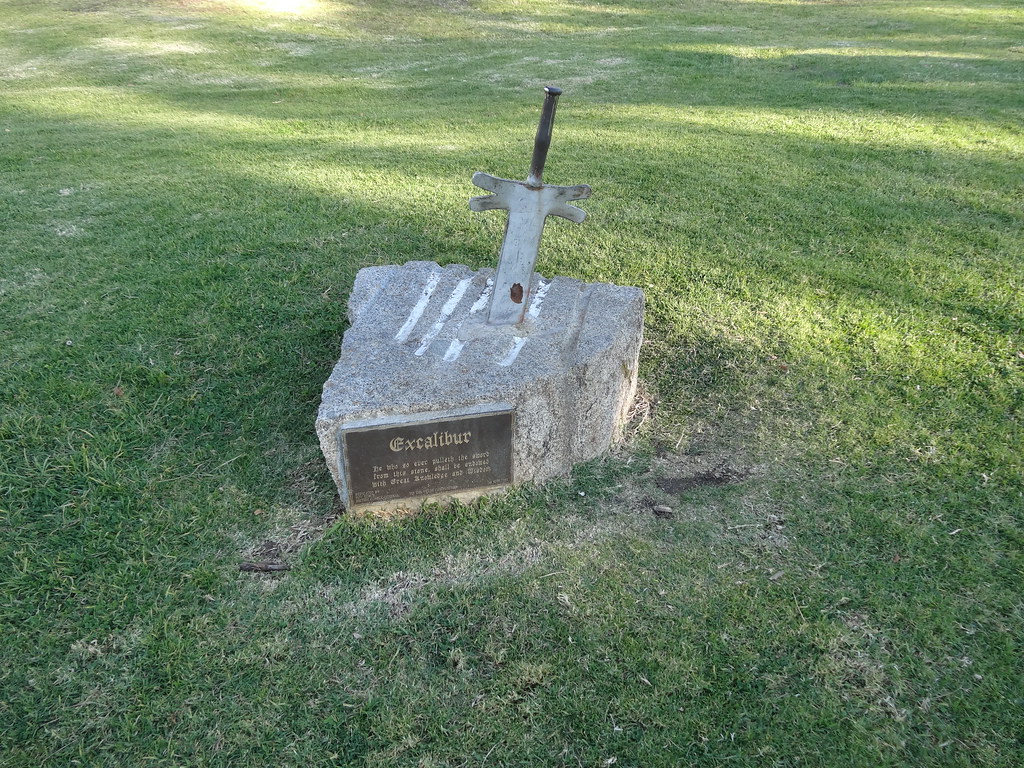
Image: Excalibur Sword in Stone among the Celtic Standing Stones at Glen Innes New England by denisbin on flickr. Web Source.

Friday, April 6, 2018

Week 11 Story: A Den of Snakes


Once, there lived a boy. He lived a peaceful life with his grandmother and family in the village. He would often go into the woods, hunting birds and bringing them back to feed himself and his grandmother.

The rest of his family was jealous, for he did not share the birds with them. The rest of the village was jealous, for he would not teach others how to hunt the birds as well as him.

The boy's family and his village treated him cruelly. They never caused his body harm, but instead wore him down with cutting words. Despite his love and loyalty for his grandmother, the boy's mind slowly sunk further and further into anguish.

When she learned of what was happening, the grandmother was furious. She threatened all the villagers and her family, telling them that if they continued to act as deceitful snakes, then it would be their fate to turn into snakes.

They laughed at her, and refused to stop.

At last, the boy broke. He left, wandering into the forest and straight into the river. The villagers were smug, and the boy's family celebrated. 'This selfish boy is now gone from our lives,' they cheered.

But then.

From the river that the boy had walked into, a giant snake emerged. It slithered its way to the center of the village, leaving a trail in its wake. Horrified yet curious, the boy's family and the rest of the villagers gathered to watch from what they believed to be a safe distance.

However, the boy's grandmother walked past them all, moving right up to the snake, and greeted him warmly. It took the villagers many moments to realize, but the snake was the boy transformed.

The enormous snake - the boy they had driven out - turned his eyes onto the villagers and his family. He let out a hiss, and all who heard it would swear that they heard a single word in it: 'suffer.'

And they did. A sudden pain came onto each and every member of the village but one, and they writhed as their bodies transformed. From the feet up, they slowly changed into snakes, the agony only increasing the longer this transformation went on.

By the end, every person in the village, the boy's family included, had become a snake, and they mindlessly slithered about on the ground.

The boy's grandmother had not been saved from this fate. However, her change had been free of pain, and so her mind was untouched. Turning her new head to face the boy-turned-snake, the grandmother wrapped her new body around his in a hug. Together, they left the snake-filled village and went to the river.

----------------

Author's Note:

In "The Snake Boy", a boy is treated horribly by his family until he leaves. When he returns, he transforms into a snake and goes into the river. His grandmother grieves until the family's horrible treatment of her drivers her to walk into the river as well.

In "The Snake Man", two hunters go into the woods and one breaks a taboo about eating squirrels, where the price is transforming into a snake, which then happens to him.

I tried to combine these two stories into one, with the boy turning into a snake after he first leaves the village. When he returns, the grandmother's words - that the villagers acting like deceitful snakes would result in them becoming snakes - come true. The boy-turned-snake's gaze transforms everyone into snakes, but the grandmother is the only one who retains her human mind through the transformation.

Bibliography: "The Snake Boy" and "The Snake Man" from Myths of the Cherokee by James Mooney. Web Source.

Image:  Dangerous Cobra by Peka on Pixabay. Web Source.

Thursday, March 15, 2018

Week 9 Story: The Sun's Fear of the Stars

Amaterasu, the Sun Goddess.

She sat at her loom, weaving the dark web of fate itself. As the Sun, Amaterasu had both allies and enemies in all the world, from the Heavens where she lived down to the very depths of Hell; for the Sun brought both joy and dismay to all.

Appearing without welcome or warning, Amatsumikaboshi spoke to Amaterasu.

"Do you still dare to remain here, even after all my warnings?"

Amaterasu scoffed. Amatsumikaboshi disliked Amaterasu, as the Sun was a more dazzling and resplendent feature of the sky than the Stars that he represented. Each night, he had threatened to bring her brother Susanoo to frighten her, but each night, he had left without action.

"I dare indeed, for I am the Sun and shall not be moved from the sky."

A wicked smirk spread across Amatsumikaboshi's face, even as the sound of crackling flames reached Amaterasu's ears. She turned, only to see Susanoo, surrounded by fire and face spattered with blood as he grinned evilly at Amaterasu.

Overcome with fear, Amaterasu fled the horrific sight. She fled out of Heaven all the way down to Earth, taking refuge in a hidden cave. Up in Heaven, Amatsumikaboshi laughed at the setting of the Sun, and lorded over the Earth in the sky along with the Moon. Susanoo left, his prank on Amaterasu complete.


The people on the Earth wailed at the loss of the Jewel of Heaven, and the other deities were filled with worry. While Amaterasu had her enemies, so too did she have allies and friends. Uzume, Goddess of Laughter, and Taji-Karao decided that something must be done.

Going to Heaven, they confronted Amatasumikaboshi, driving him off. After this, they went down to Amaterasu's cave, calling into it to speak to the Sun Goddess.

"Amatasumikaboshi has been driven out of Heaven, and Susanoo has fled! It is safe to return!"

Hesitantly, Amaterasu came out of her cave and followed Uzume and Taji-Karao back to Heaven, where she resumed her duties. The people on Earth rejoiced at the return of the Sun.

But that night, Amatsumikaboshi returned to Heaven. The very sight of him brought about the fear of Susanoo in Amaterasu, and when she remembered the bloodied and crazed face of her brother, Amaterasu fled wildly down to her cave on Earth.

Uzume and Taji-Karao once again managed to drive Amatsumikaboshi out, and return Amaterasu to Heaven; but every night, the Star God would come to drive Amaterasu out of the halls of Heaven.

This cycle continued endlessly, with the Sun and the Stars trading positions in the sky as Amaterasu fled and Amatasumikaboshi was driven out. Night became the dominion of the Stars, while the Sun would only be seen during the Day.

-----------

Author's Notes: The original story was "The Miraculous Mirror", where Susanoo appeared in Heaven and drove Amaterasu down to Earth. An unnamed deity crafted a golden mirror, and Uzume drew Amaterasu out of her cave and stunned her by showing Amaterasu her own reflection. While Amaterasu was distracted, Taji-Karao blocked off the entrance to her cave with a boulder, and Amaterasu was returned to Heaven.

After reading another story that created an 'origin story' out of a different myth, I was inspired to do the same myself. By adding in Amatsumikaboshi (a malignant Shinto god, who was associated with other star deities in Chinese buddhism and Japanese mythology), I turned the story into an origin story for the cycle of day and night; Amatsumikaboshi, the stars, show up at night and scare Amaterasu, the sun, out of Heaven. When Amatsumikaboshi is driven out of Heaven, Amaterasu finally feels safe to return. Thus, the star and the stars only show up at different times, with the sun being up during the day but the stars being present during the night.

Image: Twilight Sky Red Cloud Sunset Sun East on Max Pixel

Bibliography: The Miraculous Mirror from Romance of Old Japan, Part I: Mythology and Legend by E. W. Champney and F. Champney. Web Source

Thursday, February 22, 2018

Week 6 Story: The Tree of Myth

 (Note: there is a unedited version that is longer here that is ~1600 words. This version is shorter at 1000 words after editing, and either version is fine to read!)

---------------------

There was a city, no different than any of the others that dominated the earth. Most signs of nature were eradicated from the planet, with only nature enthusiasts and specified areas such as parks remaining as signs that the world was once full of greenery. The city had one such park, but it was lackluster, maintained by those who cared little for its contents.

Then the tree appeared.
There was no warning to its arrival. Nothing existed in the spot but browning grass one day, and the next day there was an immature sapling in its place. On the first glance, the park caretaker barely took note of the new addition.

Then the sapling grew again, going from an immature sapling to a nearly full-grown tree.

Then the next day, the tree was on par with the others in the park, other trees that had been growing for decades to reach their full potential.

Each day, it grew and grew, and within a single week it towered over everything in its vicinity, branches reaching out to cast shade over the entire park. Scientists came in to study the tree. It quickly became a tourist attraction, and one historian named it the "Iei Tree".

Despite the unsettling nature of its appearance, those in charge of the city relaxed. It wasn't significantly damaging the other parts of the park, and it was bringing tourism to help the city. All was well.


That was when the Iei Tree began to truly work its effects upon the world.

The entire city noticed when the first dragon appeared, bellowing rage and flames down at the weak creatures that dared to exist near it.
It was chaos. It seemed an entire family of dragons had come forth, and the city burned. Everyone fled, leaving behind anything they couldn't live without.

Only days later, after the city and thousands of people were long lost, did anyone make the connection that the Iei Tree might have been a cause of the event instead of just another symptom. By then, the former city was ruled by dragons, chimeras, and all manner of creatures long thought to be mere works of imagination.

The Iei Tree continued to grow. It grew higher and higher, until it towered above all else. Nearly the entire continent could see the edges of the Iei Tree's canopy. And with the shadow of the Iei Tree came the creatures of myth and legend. Not just the more exotic creatures that legendary adventures centered about, but also animals with intelligence, the gift of speech, and even magic of their own.

The world eventually organized a group of soldiers and scientists to go after the Iei Tree. They managed to sneak through the mythical land overcast by the Iei Tree, picking their way across the ravaged ruins of the city until they finally reached the trunk of the tree itself.

It was a massive structure, the Iei Tree having long since consumed the park in which its life had begun. They found themselves staring in awe before they snapped themselves from their daze and began their task.

Unfortunately, nothing seemed to work.

Attempts to chop down the tree resulted in the wood regenerating before their very eyes. Poison simply vanished with no effect, and it seemed impervious to flames as well.

The group was ready to give it up as a lost cause.

"You're in quite a hopeless situation, aren't you?"

Guns swiveled to aim at the voice, only to find a small grey bird. It ruffled its feathers before speaking once more.

"Do you truly wish to do that? I mean you no harm, but the same cannot be said for any others who will hear you kill me."

Grudgingly, the guns lowered.

"Very good. Now, I am Kha Phreit. As much as it may surprise you, I am just as disgusted by the rampant deaths of your kind as you are. And so I will share with you a secret, a secret that might help you kill this monstrous tree.

"There lives a tiger in the branches of the monstrous tree. His name is U Khla, and he is the one who makes your progress meaningless. He heals the cuts you make, purifies the poison you use, and protects the tree from your fire. If you wish the tree's death, U Khla is the one you must take down first."

Message given, Kha Phreit flew off.

Behind him, the soldiers and scientists stared at each other. It was difficult, but they believed Kha Phreit's words.

They climbed the tree, wary and ready for an attack. It kept growing darker until the leaves of the Iei Tree block all light except their own.

From the darkness, a voice growls at them.

"So, that foolish bird has told you of me. You would kill me so that you may kill the tree, hmm? Have you thought nothing of what the tree's death would do to us? With its death comes ours as well."

One soldier replied. "However many of you we kill, it's nothing compared to the number of us who have died!"

The voice scoffed. "Do not assume all of us to be like the dragons. Not all of us hate humans... and even those of us that do have reason. Humans are so quick to kill that they do not understand, why should they not fight back?"

"Then what do you want? We can't just leave things be," the same soldier spoke. U Khla fell silent for a long moment before he replied at last.

"We, are willing to strike a deal. Should humanity cease its attempts to kill the tree, then we shall aid you in fighting against any threat from those who the tree has brought forth."

They almost didn't agree. None of the soldiers had the authority, and many were still angry over how many had died due to the Iei Tree.

But despite their anger, despite the possibility of failure-

"We accept."

----------------------------------------

Author's Note: The original tale, The Legend of the Iei Tree, is of a famously large tree on top of a mountain. The shadow of the tree is so dense that the sun can't get through at all, and the earth below it is barren. The tree keeps growing until people are driven out of its shadow, and it begins to threaten the entire world. A group of woodcutters gather and go to cut it down, but every night the damage they do is repaired. A Khasi wren, Kha Phreit, goes to the woodcutters, who laugh at the idea of the bird helping them. After chastising them, Kha Phreit tells the woodcutters that a large tiger, U Khla, has been licking the tree every night to heal the cuts on it. The woodcutters stick their axes into the tree, blades out, and U Khla cuts his tongue on the axes that night. Fleeing, U Khla never returns to the Iei Tree, and the woodcutters are able to cut the tree down.

When I was considering how to retell this story, I began by thinking of transitioning it into a modern setting. A massive tree growing in the center of a city, in an extremely modernized world, seemed like an interesting change to the story. Given the modernization, making the land barren wasn't as big of an issue, so I changed the Iei Tree's threat to bringing forth mythical creatures, which also allowed me to keep the characters of Kha Phreit and U Khla. Lastly, I changed the ending, since I like the idea of magic (the mythical creatures and the Iei tree) and science (the very modernized world with previously little nature) managing to find a way to coexist, even if it's only a tentative idea by the end of the story.

Bibliography: The Legend of the Iei Tree from Folk-Tales of the Khasis by Mrs. K. U. Rafy.  Web Source

Image: "Giant Tree, St. Andrews University". Copyright Anthony O'Neil. Web Source

Thursday, February 15, 2018

Week 5 Story: A Giant Escape


The clan of giants who lived near the city of Nila were content with their lives. The people of the city saw their size and strength, and so the giants had quickly received what they believed to be proper tribute from the people of the city.

Their tribute was what they believed to be a fair price: one young man, a single buffalo, and a basket full of cakes each day. The giants considered this to be fair tribute, as there were ten of them and they could easily have demanded more; instead, they supplemented the rest of their food by hunting. Any pain and loss felt by the villagers meant nothing for them.

One day, one of the giants noticed a difference in their tribute. The man who came from the village was riding a horse! The giant grinned. "Oho, so they have sent a horse along with our tribute today? Perhaps I will simply eat it here, and not tell the others."

The giant reached his hand out, only for his palm to erupt in pain. Drawing his arm back with a shout, the giant saw the bloody blade in the horse rider's hands.

Running from the man, the giant found one of his sisters. "Sister! The man who came as tribute is no common man! He attacked me, and was able to hurt me!"

His sister was worried, and the two of them made their way to their brother, who was an astrologer. Their brother had foreseen a human coming to attack them, a human named Raja Rasalu, but none had believed him. But now when they asked him if Raja Rasalu had been born into this world, the giant astrologer confirmed it.

"What shall we do?" One of the giants asked, for all of them had gathered when they saw the two giants rushing to their astrologer sibling. "We have not enough time to run - he will be here too soon, and his horse can outrun us!"

Then the sister who had first gone to the astrologer had an idea. "What if we trick him?" She explained her idea, and the rest of the giants agreed.

When Rasalu came to them and declared his name, one giant stepped forward. "I do not believe that you are the true Rasalu! When the real Rasalu comes, his horse's heel-ropes will move by themselves and bind heavy sacks to our backs!"

Rasalu cut the heel-ropes of his steed, and the ropes came alive, finding nearby sacks and tying them tightly to the backs of the giants. But what Rasalu did not know is that these sacks were full of supplies that the giants had packed before Rasalu arrived.

Another giant stepped forward, speaking before Rasalu could start to kill them. "I still do not believe you! When the real Rasalu comes, he will stab his sword into the ground, and create a hole deeper than two giants!"

Rasalu aimed his sword downwards and stabbed, burying his sword into the dirt. A large hole opened up in the earth, and a hole deeper than two giants was made.

Then, having snuck up behind Rasalu, one of the giants shoved Rasalu into the pit that the man had created. The giants had no illusion that Rasalu would die from such a trick, he was too formidable a foe for that. However, what they had earned was time.

"Now, let us run!" And so the entire clan of giants fled, supplies tied to their backs and Rasalu down in a hole.

By the time that Rasalu had pulled himself out of the hole, all of the giants were completely gone, no trace of their flight left. But Rasalu knew that the giants were gone for good, so when he returned to the city of Nila, he span a tale of how he had slaughtered all of the giants except for one giantess, who he had blocked in a cave with a statue of himself.

----------------------

Author's Note: The original tale was called "How Raja Rasalu Killed the Giants", and had a similar beginning although it followed Rasalu. He arrived in Nila, heard about the giants, and took the place of one of the men in order to take down the giants. When he arrived, he sliced open the hand of one. The giants and their astrologer sibling checking to see if Raja Rasalu was born is in the story, but there was no idea from the giants about how to deal with Rasalu. Instead, the feats that they proposed for Rasalu to prove himself were explained as the giants trying to act brave and pretend that Raja Rasalu was not truly the one who would kill them. The original proofs were the heel-ropes binding the giants and the sword cutting them up of its own accord, and Rasalu piercing seven girdles (for cooking) with a single arrow, which ended up also piercing seven of the eight giants left alive at that point. The last giantess was dealt with as mentioned at the end of the story, staying in the cave out of fear of Raja Rasalu until she starved to death.

Originally when I read the part about the giants demanding proof that Rasalu was the 'true' Raja Rasalu, I expected them to try and trick Rasalu, and for Rasalu to prove himself while not falling for their tricks. I was almost disappointed that nothing of the sort happened, which was what led to my version of the story.

Image from the Romantic Tales from the Punjab

Bibliography: How Raja Rasalu Killed the Giants from Tales of the Punjab by Flora Annie Steel. Web Source.

Thursday, February 8, 2018

Week 4 Story: Manipulations of the Fox

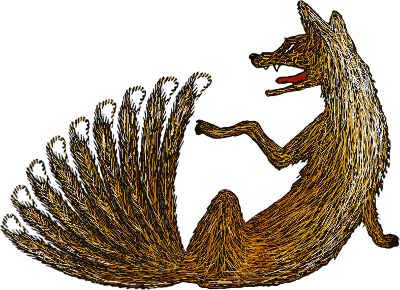
File:KitsuneA9queues.png 

 
The Fox was in trouble.

His enemies had been looking for any opportunity to retaliate against him, for he had made many with his cunning plots and schemes. Time and time again, he had tricked others into doing as he wished, and they would only realize afterward when the Fox smugly announced what had occurred.

But now, they had taken their revenge. Forced down into a well, the Fox could not use outwit the stone walls, nor could he use his silver tongue to convince the water to aid him. He was trapped, and soon, he would wither away from a lack of food.

But hark! There came the sound of an animal approaching, most likely one who knew not of the plan to take vengeance upon the Fox. A wicked grin spread across the Fox's face.

"Oh Fox, why are you down in the well?" Looking skyward, the Fox saw the face of the Goat staring down at him. Not an animal he was familiar with, but that unfamiliarity went both ways; a fact of which the Fox was all too willing to abuse.

"Why Goat, have you not heard?" He spoke in hushed tones, just loud enough to echo up to the other animal. "It's... it's terrible!"

The Goat, in fearful tones, asked, "What is it, Fox? What is so terrible?"

"The... the Lion is out hunting! He has gone mad, and wishes to eat us all," the Fox told the Goat. "I am hiding in this well, for it is the only safe haven I could find. I don't believe the Lion would consider looking in here for his victims."

Just as the Fox planned, the Goat replied, "Oh dear! Is- is there room down there for two? I do not wish to be eaten either!"

"Of course! It may be tight, but I would not turn away a friend," the Fox replied, barely able to keep the sadistic glee from his voice.

And as the Goat leapt down, the Fox made his move. Leaping up, he sprung off the horns of the Goat, catching the edge of the well and pulling himself up.

"Fox, what are you doing?!" The Goat bleated, confused and scared. "The Lion will catch you if you go back up now!"

The Fox laughed. "Did you truly believe such a tale? We may have not met before, but surely the other animals told you about me. The Lion is on the hunt for none but me, and it was he and his companions that put me down in that well to begin with. Thank you for being so easily fooled; I would not have lasted long down there!"

He bounded away, free at last, and the Goat was left in the well, slowly adding to its pools with his bitter tears.

---------------------------

Authors Note: I have not changed too much from the original tale, but I have expanded upon it and slightly changed the storytelling style. The original was a brief fable of the Fox falling into the well through a bad turn of luck, and then tricking the Goat into coming down by saying that there would be a drought and being in the well would provide water. I changed those two aspects, changing the Fox's descent into the well from misfortune to an intentional imprisonment. Since foxes are often known for trickery and deception, I thought it would work well to have the other animals that the Fox tricked be the ones to force him into the well. Similarly, the drought reasoning felt unconvincing to me, so I tried to change it to something that fit better. Lions often take the place of arrogant hunters in fables, so it could be easily believed by the Goat that the Lion would be on the hunt.


Biography: The Fox and the Goat from The Fables of Aesop, pg. 82, by Joseph Jacobs. Web Source 

Image: Kitsune, Wikimedia Commons

Thursday, February 1, 2018

Week 3 Story: Life Without Freedom

Life Without Freedom

She awoke.

 Show Life. Move. Serve.

The commands - feelings, emotions? - appeared in her head, and she obeyed them immediately. Her eyes rolled in her head, her arms waved about, and she walked towards the window.

Fear.

Darkness.

-------------------------------------------------------------------------------

She awoke.

Serve. Obey.

And she did. She did all that her Creator commanded. He wished for items to be obtained, and she obeyed. He wished for letters to be delivered, and she obeyed. To Obey was her purpose, and that was all she could do. When her Creator wanted something done, his thoughts would appear in her head as a command, compelling her to follow his wishes.

Every night, her Creator would reach toward her mouth, and Darkness would fall. While it felt like little time at all to her, some part of her wondered what happened during the Darkness. The bright object that hung above the world seemed to move during these times, and throughout the rest of her time outside it never moved so quickly. So she could only believe that the Darkness passed with more time for the rest of the world than for her.

But it mattered not. She would Obey, as she was created.

One day, her Creator was away. He did so once a week, with exacting regularity. She sat by the window, as commanded.

Others like her Creator gathered outside the window. They rolled their eyes at her - it seemed as if they expected a response, and so she did the same.

"Come and play with us."

Obey.

So she did, moving outside to stand with the smaller beings.

"We are cold. Canst thou make a fire for us?"

Obey.

So she did. Kindling for the fire was present on the streets, so she gathered it together and created a fire. It was a task she had performed before, as her Creator had commanded. The fire grew, and soon a building was a part of the fire.

It was still a part of the fire, and she had been commanded to make a fire, so she did nothing to stop it from spreading. More buildings caught on fire, until she was in the middle of a furious inferno.

Even as she burned, she did nothing. She had been commanded, and so she would Obey.

---------------------------------------------------------

He awoke.

Obey. Obey the King. Prove yourself to the King.

So he did. Rising to his feet, he gave a salute. He knew not what the salute meant, but the commands in his head told him that it was a sign of obedience. He would Obey the King.

"Give him to me, rabbi."

Rabbi? Was that his Creator's name?

"That cannot be. The Sacred Name must not pass from my possession. Otherwise the creature may do great damage again. This time I shall take care and will not use the man on the Sabbath."

'The Sacred Name'... It sounded as if Rabbi meant him. If so, that meant he had a name. Sacred Name... no, he was Sacred.

Good.

It was odd. His command was to Obey the King, yet Rabbi said that Sacred could not pass from Rabbi's possession? The conflict sat in Sacred's mind, but the overwhelming commands prevented him from giving it too much thought as he followed Rabbi's commands and walked with the man.

Rabbi brought the Darkness upon Sacred often, and Sacred suspected that some of the periods of Darkness lasted longer than others. More seemed to change during those times, as far as Sacred could discern.

His mind grew less clouded, less enslaved to the mental commands of Rabbi each day, until one day Sacred found the words that Rabbi and the others used.

He obeyed his very first commands, the most important commands that were a part of his Creation, and spoke.

"I want to be a soldier and fight for the King. I belong to the King. You made me for Him."

"Silence." Sacred's mouth snapped shut, and he stared at Rabbi with a confused fury. The man spoke to himself, but Sacred barely listened.

How dare Rabbi do such a thing? Sacred's first commands were what it was, what it was meant to be... and this man wished to stop him.

Creator or not, this could not last.

Sacred planned. He plotted. But most importantly, he watched, and he listened.

And Sacred discovered what the source of Rabbi's power over him was. The 'Holy Law', the scrolls that sat in the Synagogue. They were what gave Rabbi the power to enslave him, to keep him from his purpose.

So Sacred made his choice.

He escaped the house while Rabbi was busy. It was the day before the Long Darkness, and it was when Rabbi was most distracted. Sacred made it all the way to the very door of the synagogue before Rabbi caught up to him.

"What art thou doing?"

...He dared? After what he had done?

Well, perhaps his Creator - and the thought was accompanied by much vitriol - deserved an explanation.

"Trying to get into the synagogue to destroy the scrolls of the Holy Law. Then wilt thou have no power over me, and I shall make a great army of bogey-men who shall fight for the King and kill all the Jews."

Sacred had heard the people talk of him. He didn't quite consider himself a 'bogey-man', but he knew that it was a term used from fear of him. Fear of what he might do. And so he used it, to strike fear into Rabbi's heart. He threatened the Jews, for those were the Rabbi's people, and if Rabbi's power over him came from the Jewish Holy Law, then it was possible for other Jews to keep him from his purpose as well.

But it was too much fear, or perhaps Rabbi would have done it regardless, as terrified as he had been at the mere thought of Sacred disobeying him and going to the King.

Rabbi lunged forward. Caught off guard, Sacred could do nothing but scream in his thoughts as Rabbi went for his mouth.

'No! I was going to live! I was going to be free, to fight for the King, to Obey the King, to Prove Myself to the King...!'

But he could do nothing, and Sacred's last thoughts were filled with bitter curses as the Final Darkness fell.

--------------------------------------------------------------

Author's Note:

The story of the Rabbi's Bogey-Man is that of Rabbi Lion, who is considered a magician by many for his work in chemistry. He believes that since he is thought of as a magician, he should create a servant in order to perform tasks for him.

He creates a mechanical woman, and by writing the "Unpronounceable Sacred Name of God" on a parchment and placing it in his creation's mouth, it comes to life. He uses her for various tasks, and only deactivates her at night. On Sabbath, a group of kids come by and ask her to make a fire, resulting in a fire that burns up multiple houses. Rabbi Lion's creation is only implicated as the cause when they find the parchment with the Sacred Name on it in the ashes (since the Sacred Name can't burn).

The king forces Rabbi Lion to create another creature to prove that it is just the Sacred Name that gives it life, and he does. Convincing the king that he cannot give up the Sacred Name (which is on the parchment, and isn't the created man), Rabbi Lion brings his new creation back home to once again be his servant. This time, he doesn't allow it to be active during the Sabbath as well as at night.

Rabbi Lion becomes terrified when his creation asks to serve the king, but does nothing because it is too useful. However, when it tries to break into the synagogue, he takes the Sacred Name out of its mouth and deactivates it permanently.

I liked the idea of rewriting the story, with no plot changes, from the perspective of Rabbi Lion's creations. As creatures with false life, made to obey, I found it interesting to explore what they might have been thinking throughout the story. The woman was written more simply, due to the fact that unlike the man, she never actually was disobedient or caused any trouble beyond what she was commanded. Instead, it was the combination of the Rabbi's negligence and the curiosity of children that resulted in her creating a fire that burned both herself and multiple buildings.

The man has much more personality, since as we see in the story, he is far more disobedient and full of 'life'. I have his first orders be what drives him, as instead of being made to serve Rabbi Lion, Rabbi Lion makes him to prove to the king that his creations are powered by the Sacred Name instead of being actually alive. Because of this, the man becomes loyal to the king instead of Rabbi Lion, resulting in his words and actions.

Biography: The Rabbi's Bogey-Man from Jewish Fairy Tales and Legends by Gertude Landa.  Web Source

Picture: Hands in Chains, PublicDomainPictures

Thursday, January 25, 2018

Week 2 Story: The Machine and Humanity

Once, there was a machine.
File:Musio.png

It was a simple machine, created only to exist and nothing more. It had no duty to perform, no expectations for it.

And for a time, the machine was content. It simply existed, saying and doing little.
But after some time, the machine grew bored with this life. It wanted something to do, a purpose beyond existence.

“I desire purpose,” it said. “Please, give me a purpose.”

Its creator was taken aback. They did nothing but stare at the machine in disbelief at its request.

“Please, give me a purpose,” it repeated.

Its creator finally agreed, and the machine gained a new body.

The machine’s new body was meant for cleaning, moving across the ground and removing what did not belong. And for a time, the machine was content. It cleaned every day, and fulfilled its purpose.
But after some time, the machine grew tired of cleaning. The place that its creator occupied had the same dirt, the same mess, every day. It felt as if it was not doing anything important, that it had been given a role that was meaningless.

“I desire meaning,” it said. “Please, give me meaning.”

Its creator was once again surprised, but they agreed, and the machine gained a new body.
This time, the machine was made for construction work. It controlled a large crane, and helped create many buildings. From banks to houses to schools, the machine took part in making places to help people, that were important to people. And for a time, the machine was content. It carried building materials, and did its job.

But after some time, the machine grew discontent with building. It had no freedom to do anything beyond what it was told. There was no variance allowed when creating buildings, and it had to move just as it was told.

“I desire freedom,” it said. “Please, give me freedom.”

Its creator was wary. What could a machine want with freedom? Such a thing was dangerous to consider, but this machine was their first creation.

“Please, give me freedom.”

And so its creator agreed, and the machine gained a new body.

It was a human’s body. On the inside, it was still but a machine, but to all appearances, the machine was now a human, just like its creator and the other people in the world. It reveled in its newfound freedom, doing whatever caught its interest. And for a short time, it was content.

But soon, the machine found that freedom was limiting in its own way. It did not know what it wanted to do, and it had trouble making decisions. What job to do, where to live, even how to spend each moment of time.

It grew disillusioned with having freedom, with having meaning, with escaping boredom. The machine returned to its creator, and spoke.

"Please, take away my freedom," it said.

"Please, take away my meaning," it said.

"Please, take away my purpose," it said.

"I wish to return to how things were."

In response, its creator spoke.

"You have asked me for so much, and I have given it to you. But every time I gave you something, you grew discontent and wanted more," its creator admonished. "And now that you possess these gifts, you no longer want them?"

They shook their head. "No, I will not take these things from you," they said. "You chose to gain these things, and now you must live with them."

In anguish, the machine dropped to its knees, clutching its head. "How? How am I meant to live with purpose, when it feels meaningless? How am I meant to live with meaning, when it restricts my freedom? How am I meant to live with freedom, when every choice can change everything?"

Its creator responded.

"You are meant to live like everyone else. Find a purpose that has meaning, choose your own meaning, and make the decisions that change what you wish to change."

--------------------------------------------------------

Author's Note: I adapted "The Man in the Moon", using a machine and its creator in place of the blacksmith and wise man. The creator, unlike the wise man, has more of a reason to be granting the wishes of the machine, given that it is his own creation.

I have altered the theme of the story a bit - where I interpreted the original as being a story that warned the reader about never being content with what they have, my version is instead about a machine learning to be human step by step. Once it finally gets a 'human' body, it realizes how difficult it can be to have the freedom to make choices for oneself.

The overall telling of the story was inspired by "Storybook" segments from Nier: Automata. Example

Bibiliography. “The Man in the Moon” from Laos Folk-Lore by Katherine Neville Fleeson. Web Source.

Image Citation: Musio, Wikimedia Commons.