Showing posts with label Week 3. Show all posts

Sunday, February 4, 2018

Wikipedia Trail: From "Golem" to "Motif (narrative)"

Golem: I was interested in golems because of my story choice from this past week; golems are from Jewish folklore, and I used a Jewish fairy tale where a Rabbi brought two mechanical creations to life using the "Name of God" written on a parchment. It sounded very much like I believed a golem to be, although the term was never used in the original tale, instead calling them "mechanical creations" or "bogey-men".
The source of the word golem was in the Bible, where it was used to describe the "unfinished human being before God's eyes". Additionally, the earliest story of a golem is described on the Wikipedia page as being Adam's - the first human's - creation, before he was truly made into a human. Interestingly, while there are multiple examples given for stories of golems, the story of Rabbi Lion's bogey-men is not mentioned, which implies that it is either not seen as a golem story or is not well-known enough to be included.

Creation of man from clay: Since golems are usually created from mud or clay, and the previous article mentions that golems are equivalent to unfinished humans, I was interested in seeing how many different cultures also have the theme of humanity being created out of clay - as golems of a sort.
File:Stworzenie Adama by T Kowalski.jpg

(Stworzenie Adama by T Kowalski, "Fashioning a man out of clay" [Wikipedia])

The list is rather significant, including Sumerian mythology, Judaism/Christianity with the Bible (as expected from what was learned on the golem page), the Qur'an, the Greek, Egyptian, Incan, and Chinese mythologies, and more. It surprises me to see how many different religions and cultures seem to have origin myths that involve humanity being created from clay (or earth, or mud), especially since it is highly unlikely that these cultures came into contact with each other prior to these myths existing. It brings to mind the idea that there is an underlying human consciousness, or that certain themes are 'natural' for humans to think about.

Theme (narrative): Given the prolific nature of the theme of humanity being created from clay, I was interested to see if there was any more about that kind of theme (as mentioned at the end of the previous page's thoughts).

The different ways that themes can be expressed is interesting, especially in the case of expressing the same theme different ways. "Leitworstil" is the repetition of certain wording to draw the attention of a reader, which reminds me of the more well-known term "leitmotif", which (to my knowledge) is a repeated musical theme in a work that is related to a certain part of the story, such as a character or setting.

Motif (narrative): Due to thinking of a leitmotif, I was interested to see if the page for motif had any more specific information about that. Based on the initial description, it sounds like a motif is often used for expressing themes (which is brought up as a potential way to express theme in the "Thematic patterning" part of the theme page, talking about inserting recurring motifs into a narrative). Motifs seem very broad from this page, being "any recurring element that has symbolic significance in a story" - essentially, just any element of a story that isn't meaningless and shows up multiple times.

Based on the "See also", it seems that there are different definitions of motif for different types of art, as "folkloristics", "music", and "visual arts" are all different "Motif" pages of their own.

Topic Research: The Epic of Gilgamesh


Due to the nature of the Epic of Gilgamesh, I think that a retelling without changing any of the known detail or plot gives me a lot of freedom to write. Since the epic had to be translated, and there were gaps in the text due to the tablets being defaced, the Epic of Gilgamesh (found in Myths & Legends of Babylonia & Assyria by Lewis Spence) is more of a summary than a properly told story.

I think that the tale of Gilgamesh and Eabani (also known as Enkita or Enkidu) could be told well as either a story focusing on both of their perspectives - Gilgamesh, who is the 'tyrant hero' and wishes to twist the plans of the gods, and Eabani, who has little knowledge of the plans of the gods and is interested in befriending Gilgamesh after being told of him. There is no text detailing how exactly the two meet and become friends, so the details are completely up to my own devising. It is implied that they do not fight, as Eabani "wisely refrained from combat", but how they act towards each other prior to and in the process of forming their friendship is up to my own decision.

The story of Ishtar and the mighty bull Alu would also be an interesting tale. I could possibly tell it from either side of the story, from Gilgamesh and/or Eabani's perspectives or from Ishtar's, but I think that I would enjoy writing the former more, since the focus would be more on Gilgamesh and Eabani that way. The battle against Alu is missing from the text, so again I have more freedom with the details of what happened. In particular, this story would be great to use because at the end, Eabani dies, which results in a strong reaction from Gilgamesh and is likely a result of Ishtar cursing him in a rage due to the slaying of Alu.

Gilgamesh's reaction to Eabani's death is a long tale, but captures very well how Gilgamesh mourns the death of his friend, and subsequently begins to fear death and search for an escape from it. Many creatures and deities along Gilgamesh's path warn him away from this search, but he continues until he meets Ut-Napishtim. There is a long discussion between the two (which, due to being the Babylonian flood myth, could be its own story by itself - so I will almost definitely summarize or skip over it for my retelling!), and Ut-Napishtim eventually directs Gilgamesh towards where the plant of life would be found. Gilgamesh finds it and goes to bring it back to his kingdom, but a serpent steals it on the way back. Upon his return to his kingdom, Gilgamesh still grieves Eabani. He cries to Ea, who persuades Nergal (the deity of the underworld) to bring forth the shade of Eabani. Eabani tells Gilgamesh of the state of the underworld, and how those whose bodies are not treated properly suffer in the afterlife (Eabani is not one of these, and his spirit is a 'happy' one). There is a significant amount of story here, and I will definitely have to summarize a lot of it unless I intend to split it into two stories; the trip to Ut-Napishtim, and then the plant of life and the summoning of Eabani's spirit. Depending on what I want to include, I might separate those differently, but splitting this into two tales would give me more freedom to include further details instead of feeling constrained by fitting all that happens into one story.

Given Gilgamesh's role as a king, and my intent to try and show off how his role as king resulted in both his heroic and tyrannic sides, I think that this image of a golden throne chair matches my project direction. Unfortunately, there are not many convenient color images that work for both Gilgamesh/Ancient Babylonia and the direction I wish to take my retellings, so I went for the latter.

File:Warsaw Throne chair of Stanislaus Augustus.jpg
(Warsaw Throne chair of Stanislaus Augustus, Wikimedia Commons)

Thursday, February 1, 2018

Week 3 Story: Life Without Freedom

Life Without Freedom

She awoke.

 Show Life. Move. Serve.

The commands - feelings, emotions? - appeared in her head, and she obeyed them immediately. Her eyes rolled in her head, her arms waved about, and she walked towards the window.

Fear.

Darkness.

-------------------------------------------------------------------------------

She awoke.

Serve. Obey.

And she did. She did all that her Creator commanded. He wished for items to be obtained, and she obeyed. He wished for letters to be delivered, and she obeyed. To Obey was her purpose, and that was all she could do. When her Creator wanted something done, his thoughts would appear in her head as a command, compelling her to follow his wishes.

Every night, her Creator would reach toward her mouth, and Darkness would fall. While it felt like little time at all to her, some part of her wondered what happened during the Darkness. The bright object that hung above the world seemed to move during these times, and throughout the rest of her time outside it never moved so quickly. So she could only believe that the Darkness passed with more time for the rest of the world than for her.

But it mattered not. She would Obey, as she was created.

One day, her Creator was away. He did so once a week, with exacting regularity. She sat by the window, as commanded.

Others like her Creator gathered outside the window. They rolled their eyes at her - it seemed as if they expected a response, and so she did the same.

"Come and play with us."

Obey.

So she did, moving outside to stand with the smaller beings.

"We are cold. Canst thou make a fire for us?"

Obey.

So she did. Kindling for the fire was present on the streets, so she gathered it together and created a fire. It was a task she had performed before, as her Creator had commanded. The fire grew, and soon a building was a part of the fire.

It was still a part of the fire, and she had been commanded to make a fire, so she did nothing to stop it from spreading. More buildings caught on fire, until she was in the middle of a furious inferno.

Even as she burned, she did nothing. She had been commanded, and so she would Obey.

---------------------------------------------------------

He awoke.

Obey. Obey the King. Prove yourself to the King.

So he did. Rising to his feet, he gave a salute. He knew not what the salute meant, but the commands in his head told him that it was a sign of obedience. He would Obey the King.

"Give him to me, rabbi."

Rabbi? Was that his Creator's name?

"That cannot be. The Sacred Name must not pass from my possession. Otherwise the creature may do great damage again. This time I shall take care and will not use the man on the Sabbath."

'The Sacred Name'... It sounded as if Rabbi meant him. If so, that meant he had a name. Sacred Name... no, he was Sacred.

Good.

It was odd. His command was to Obey the King, yet Rabbi said that Sacred could not pass from Rabbi's possession? The conflict sat in Sacred's mind, but the overwhelming commands prevented him from giving it too much thought as he followed Rabbi's commands and walked with the man.

Rabbi brought the Darkness upon Sacred often, and Sacred suspected that some of the periods of Darkness lasted longer than others. More seemed to change during those times, as far as Sacred could discern.

His mind grew less clouded, less enslaved to the mental commands of Rabbi each day, until one day Sacred found the words that Rabbi and the others used.

He obeyed his very first commands, the most important commands that were a part of his Creation, and spoke.

"I want to be a soldier and fight for the King. I belong to the King. You made me for Him."

"Silence." Sacred's mouth snapped shut, and he stared at Rabbi with a confused fury. The man spoke to himself, but Sacred barely listened.

How dare Rabbi do such a thing? Sacred's first commands were what it was, what it was meant to be... and this man wished to stop him.

Creator or not, this could not last.

Sacred planned. He plotted. But most importantly, he watched, and he listened.

And Sacred discovered what the source of Rabbi's power over him was. The 'Holy Law', the scrolls that sat in the Synagogue. They were what gave Rabbi the power to enslave him, to keep him from his purpose.

So Sacred made his choice.

He escaped the house while Rabbi was busy. It was the day before the Long Darkness, and it was when Rabbi was most distracted. Sacred made it all the way to the very door of the synagogue before Rabbi caught up to him.

"What art thou doing?"

...He dared? After what he had done?

Well, perhaps his Creator - and the thought was accompanied by much vitriol - deserved an explanation.

"Trying to get into the synagogue to destroy the scrolls of the Holy Law. Then wilt thou have no power over me, and I shall make a great army of bogey-men who shall fight for the King and kill all the Jews."

Sacred had heard the people talk of him. He didn't quite consider himself a 'bogey-man', but he knew that it was a term used from fear of him. Fear of what he might do. And so he used it, to strike fear into Rabbi's heart. He threatened the Jews, for those were the Rabbi's people, and if Rabbi's power over him came from the Jewish Holy Law, then it was possible for other Jews to keep him from his purpose as well.

But it was too much fear, or perhaps Rabbi would have done it regardless, as terrified as he had been at the mere thought of Sacred disobeying him and going to the King.

Rabbi lunged forward. Caught off guard, Sacred could do nothing but scream in his thoughts as Rabbi went for his mouth.

'No! I was going to live! I was going to be free, to fight for the King, to Obey the King, to Prove Myself to the King...!'

But he could do nothing, and Sacred's last thoughts were filled with bitter curses as the Final Darkness fell.

--------------------------------------------------------------

Author's Note:

The story of the Rabbi's Bogey-Man is that of Rabbi Lion, who is considered a magician by many for his work in chemistry. He believes that since he is thought of as a magician, he should create a servant in order to perform tasks for him.

He creates a mechanical woman, and by writing the "Unpronounceable Sacred Name of God" on a parchment and placing it in his creation's mouth, it comes to life. He uses her for various tasks, and only deactivates her at night. On Sabbath, a group of kids come by and ask her to make a fire, resulting in a fire that burns up multiple houses. Rabbi Lion's creation is only implicated as the cause when they find the parchment with the Sacred Name on it in the ashes (since the Sacred Name can't burn).

The king forces Rabbi Lion to create another creature to prove that it is just the Sacred Name that gives it life, and he does. Convincing the king that he cannot give up the Sacred Name (which is on the parchment, and isn't the created man), Rabbi Lion brings his new creation back home to once again be his servant. This time, he doesn't allow it to be active during the Sabbath as well as at night.

Rabbi Lion becomes terrified when his creation asks to serve the king, but does nothing because it is too useful. However, when it tries to break into the synagogue, he takes the Sacred Name out of its mouth and deactivates it permanently.

I liked the idea of rewriting the story, with no plot changes, from the perspective of Rabbi Lion's creations. As creatures with false life, made to obey, I found it interesting to explore what they might have been thinking throughout the story. The woman was written more simply, due to the fact that unlike the man, she never actually was disobedient or caused any trouble beyond what she was commanded. Instead, it was the combination of the Rabbi's negligence and the curiosity of children that resulted in her creating a fire that burned both herself and multiple buildings.

The man has much more personality, since as we see in the story, he is far more disobedient and full of 'life'. I have his first orders be what drives him, as instead of being made to serve Rabbi Lion, Rabbi Lion makes him to prove to the king that his creations are powered by the Sacred Name instead of being actually alive. Because of this, the man becomes loyal to the king instead of Rabbi Lion, resulting in his words and actions.

Biography: The Rabbi's Bogey-Man from Jewish Fairy Tales and Legends by Gertude Landa.  Web Source

Picture: Hands in Chains, PublicDomainPictures

Wednesday, January 31, 2018

Reading Notes B: The Rabbi's Bogey Man

The Rabbi's Bogey-Man - Focus on the relationship between Rabbi Lion and his creations
  • Lion decided to make himself a servant when people treated him as a magician
  • Made a mechanical woman for labor, was alarmed at first when it started to move
  • De-animated the woman at night
    • Didn't trust his creation from the beginning, believed that she would cause mischief
  • Woman got destroyed in an accidental fire she started when Lion was preaching on Sabbath and kids ordered her to make a fire for them
  • Lion says that the creature has no life except for what the Sacred Name gave it
  • New creation: man larger than the woman, made for the king
  • Trusted man less than woman, took name out during Sabbath
    • Justified, after what the woman did
    • If man doesn't know of previous creation, seems like Lion has no trust for the man at all
  • Man improved, then spoke and wanted to fight for the king
    • Said he was made for the king, belongs to the king: aware of the circumstances of his creation
  • Lion was scared of the "monster" he created, but wasn't willing to give up the usefulness of a free and efficient servant
  • Man tried to break into the synagogue and destroy the scrolls of the Holy Law in order to make more bogey-men to serve the King and kill all the Jews
    • Lack of decisive action, or attempt at understanding, on Lion's part resulted in man escalating to drastic action
    • Man's ambitions grew the longer he was forced to be a slave to Lion
    • Wanted revenge on Lion (kill all Jews)
  • Lion took parchment from man and man collapsed

(Possible Arist: Sol Aronson, Web Source)

Biography: The Rabbi's Bogey-Man from Jewish Fairy Tales and Legends by Gertude Landa.  Web Source

Tuesday, January 30, 2018

Reading Notes A: Jewish Fairy Tales

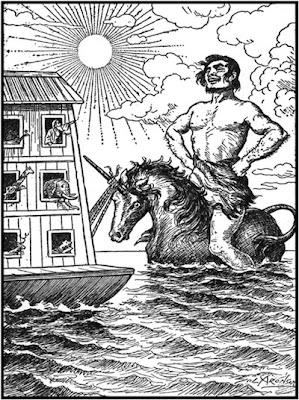
The Giant of the Flood - Focus on Og

  • Offers to bring a unicorn but only if Noah saves him as well
  • Worried more about starving to death than being drowned
  • Despite Noah's rejection, Og still brings the unicorn
    • Believes that Noah will help, or was planning to use unicorn as way to force Noah to help him (as he does later)?
  • When flood comes, Og gets on unicorn's back and threatens to steal all the unicorn's food
  • Og accepts Noah's bargain to become a servant to Noah's descendants in exchange for food
  • After rain stops, Og is happy about mortals (humans) being gone
  • Noah reminded Og about the bargain
  • Og was so upset that he refused to eat for two days
    • Bad at thinking in the future - made the deal for food, but then when reminded of the deal, got depressed
    • Overreaction to sadness - didn't eat for two days after being reminded of the bargain
  • After Ark landed, Og told Noah he was going to leave, got reminded of bargain again
    • Short memory? Bargain slipped his mind
    • OR trying to trick Noah
  • Wept tears after being reminded, and wept silently (without tears) after Noah told him not to cry (to not drown the world)
  • Complained daily about lack of food and his resulting shrinking in size, while helping build houses for Noah's children
  • Noah forced Og to carry a heavy bag of seeds when going to plant fruit and flowers
  • When planting grapes, Og offers sacrifices
  • Brings a sheep, a lion, a pig, and a monkey
    • Sheep: after a few drops of wine, man will be harmless like a sheep
    • Lion: after a little more wine, man will have a lion's strength
    • Pig: after too much wine, will turn into a "beast like the pig"
    • Monkey: more, "foolish behavior like a monkey"
  • Og offered two extra blessings (pig and monkey)
    • Seemed vindictive?
  • Og drank too much, got scolded by Abraham until he dropped a tooth from fright
  • Og became King of Bashan, broke deal with Noah and opposed Israelites when they tried to obtain Canaan
  • Grabbed a mountain to drop on Israelites, but it crumbled and fell on him and around his neck, tangled in his teeth
  • While he was distracted, Moses leapt up and sliced open the giant's ankle which killed Og 

https://blogger.googleusercontent.com/img/b/R29vZ2xl/AVvXsEjZ-u9DNBs0VL77NEk2f6NvYY9faUDhDlkHrc9016ndQDQEwwOhqcpbtlxY5pZWI13jTmmzajdNNF31wDAQAPM6c7ZYxNckSTD4dmtJZpnckJf5p97S9n5RHNNMAIg4EL2VPlIWUTrwHLk/s1600/gloodgiant.jpg

(Possible Arist: Sol Aronson, Web Source)

Bibliography: The Giant of the Flood from Jewish Fairy Tales and Legends by Gertrude Landa. Web Source