Wednesday, April 25, 2018

Week 14 Reading B: A Clever Lass

  • Shepherd finds a golden mortar and wants to give to the king
    • Daughter says that the king will want a pestle, which shepherd doesn't have
  • Shepherd gives mortar to king and he gives shepherd 3 days to give pestle
  • Shepherd laments, telling king about his daughter's words
  • King says he will marry the shepherd's daughter and not ask for the pestle if she comes to him:
    • Neither walking nor riding
    • Neither clothed nor unclothed
    • Neither by day nor by night/at noon nor in the morning
  • Daughter goes to king at the fall of dusk (not noon or morning), dressed in fishnets (neither clothed nor unclothed), partly rode on the goat and partly walked
  • King married her but told her that she must part with him if she gives advice to anybody
  • One day a farmer's mare had a foal at the market and the foal ran away to another farmer
  • King decided that since every animal runs to its mother, that the gelding had the foal instead
  • Queen told farmer in secret to take a fishing net and fish the road in front of the king
    • When the king asked why the farmer was doing it, queen told the farmer to respond "It's as hopeful as expecting a gelding to foal"
  • Farmer does so, but king realizes that someone else told him to do so
    • Interrogated farmer until he gave up the queen's name
  • King told the queen she must leave the next day, but could take the thing she like best with her
  • Queen puts opium in king's wine, tells him to drink to her health, and then takes king back to her father's old hut
  • When king wakes, queen tells him that she took him as the thing she liked best
  • King relented and told her she could give advice to anybody


Bibliography: A Clever Lass from The Key of Gold by Josef Baudis. Web Source.

Image:  Gold Mortar by valdist torms. Web Source.

Week 14 Reading A: The Waternick


  •  Two children with a widowed mother
  • Children sent off to get firewood, used wool thread to mark the trail home
  • Wild creatures broke the thread and they were lost in the forest
  • Found a pond and walked around it
  • Waternick finds children, takes them to his home by force
  • Waternick and his wife enslave the children as servants and put them to work for years
  • When Waternick leaves to catch human souls one day, wife falls asleep and children realize that they can try to escape
    • First attempt to run while she sleeps fails, she catches them
      • Waternick then puts the children to work felling trees, but the tools he gives them break
      • Waternick forgets to give them another task for the next day
    • Children release all the souls that the Waternicks caught
    • Next attempt to escape works, and children get out of the pond before the wife catches them
  • Children fall asleep and forester finds them, returns them to their mother
  • Happy ending, live together for the rest of their lives


Bibliography: The Waternick from The Key of Gold by Josef Baudis. Web Source.


Image: Underwater view in Dumbea river in the vicinity of Nakutakoin from IHA. Web Source.

Friday, April 20, 2018

Week 13 Story: The Contest of Trickery

When the Sheriff of Nottingham set up a contest of archery, all of the outlaws of Sherwood Forest knew that Robin Hood would take the bait. It was most obviously a trap, and David of Doncaster confirmed this for them.

But if they could not convince their fearless leader to not attend the archery competition - and they could not, for he would call any who did so a coward - then perhaps there was another plan they could convince him to follow.

The day of the archery contest came, and all of Robin Hood's men attended as participants. Each of them wore a hooded cloak, knowing that without proper cause, the Sheriff would not dare to force everyone to reveal themselves for fear of his citizens losing their trust in him.


Arrows flew, and one hooded figure in particular was astounding. Every shot was within the center rings, and even though the second place contestant came close, it was the hooded figure in red who took the competition.

The Sheriff of Nottingham came to greet the victor with a sickly sweet smile. He requested that the victor remove their hood, so that they could be properly awarded with the prize. But when the hood came down, the Sheriff was astounded to see that it was not Robin Hood at all! Instead of the outlaw, it was simply a skilled archer from out of town, who had heard of the contest and journeyed to take part.

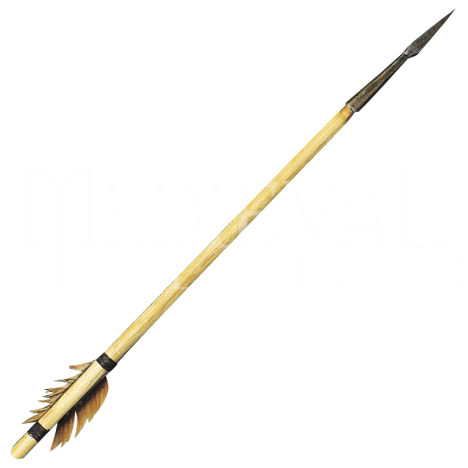
Disappointed at his failure to lure out Robin Hood, the Sheriff went to give the victor his prize: an arrow with a golden head and a silver shaft.

However, instead of the arrow, the Sheriff found an archery target in its place. It was the target of the second place archer, and the arrows upon it formed a pattern: an "H" made up of arrows. The Sheriff raged at the sight, for it was clear to him what had happened.

Robin Hood had thrown the competition, purposefully avoiding a perfect score and allowing the other man to win. Instead, he chose to make his shots into a letter representing his name. It both identified him to the Sheriff after the fact, and proved that his accuracy was superior to the victor. And then the outlaw had claimed the prize that he would have received had he shot true, and left his target as a message.

While he did not officially win the archery competition that day, Robin Hood won in all the ways that mattered. He outplayed the Sheriff at trickery, escaping the trap set for him, and he made off with the prize with which the Sheriff had baited the trap. Yet another victory for Robin Hood over his nemesis, the Sheriff of Nottingham!

Author's Notes:

In the original story, the Sheriff's plan failed because Robin Hood and his men attended in hooded cloaks, and so the Sheriff and his men could not see them. Robin Hood then won the competition and took home the golden arrow, letting the Sheriff know of his failure by shooting a message via arrow into the town.

It seemed odd to me that the Sheriff would not be wary of people hiding themselves in a trap he set for Robin Hood, so I had both the Sheriff and Robin Hood do more with the plan. The Sheriff knew Robin Hood could win the archery competition, so he decided to unmask whoever won in order to catch Robin Hood, relying on the outlaw's pride. However, Robin Hood and his men managed to outsmart the Sheriff. By shooting a specific pattern into his target, Robin Hood proved that his accuracy was superior to the other archers without becoming the actual victor of the contest. Then, when the Sheriff was distracted with the winner, he stole the prize and left his target as a message. The end result is very similar to the original, with Robin Hood escaping with the golden arrow, but it attributes a bit more cunning to both sides.

Bibliography: Robin Hood and the Golden Arrow from The English and Scottish Popular Ballads by Francis James Child. Web Source.

Image: Archery Target on pixabay. Web Source.

Thursday, April 19, 2018

Week 13 Extra Credit Reading: The Golden Arrow


  • Sheriff of Nottingham disliked Robin Hood
  • Reported to King Richard about his losses
  • King replies that Sheriff of Nottingham is the sheriff, should come up with some "tricking game" to deal with the rebels
    • There were bowmen in the outlaws, so prize would be an arrow with a golden head and silver shaft
  • Robin Hood wishes to go, but David of Doncaster tells him that the match is a trick
    • Robin Hood insists on going, calling David a coward
  • Gang disguised themselves to attend
  • Sheriff and others could not find Robin Hood among the competitors
    • Sheriff insults Robin Hood, who was irritated but did not reveal himself
  • Robin Hood won the contest, wanted to reveal to the Sheriff that he won it
    • Happened back in Greenwood
  • Little John suggested writing a letter, and Robin Hood sent it by attaching it to an arrow and shooting it into town
Bibliography: Robin Hood and the Golden Arrow from The English and Scottish Popular Ballads by Francis James Child. Web Source.

Image: Arrow Bow from pngimg. Web Source.

Wednesday, April 18, 2018

Week 13 Reading A: Robin Hood's Delight

  • Will Scarlock, Little John, and Robin Hood
    • Outlaws
    • "Men of a noble blood"
      • Simply that they were noble people, or were they formerly of the noble caste?
    • Lived in Sheerwood (Sherwood)
  • Came across 3 keepers clad in green in the forest
    • Midsummer day
  • 3 Keepers
    • King Henry's deer keepers
    • Armed with faucheons (falchions) and forest-bills (weapons)
  • Robin Hood accuses keepers of being devils
    • Likely for not letting any others hunt the deer
  • Robin Hood challenges the keepers, but they refuse
    • Keepers aren't afraid of the outlaws; keepers don't believe that they've done anything wrong
  • Robin Hood identifies himself, and keepers decide to fight
  • Outlaws are losing, Robin Hood tries to convince keepers to let him blow his bugle-horn before continuing to fight
    • Keepers don't believe it will do anything to them
    • They refuse the deal
  • Robin Hood declares that they won't fight anymore, and invites keepers to come to Nottingham with them and 'fight' there with wine
  • Outlaws and keepers go to Nottingham and drink for three days, becoming friends

Bibliography: Robin Hood's Delight from The English and Scottish Popular Ballads by Francis James Child. Web Source.

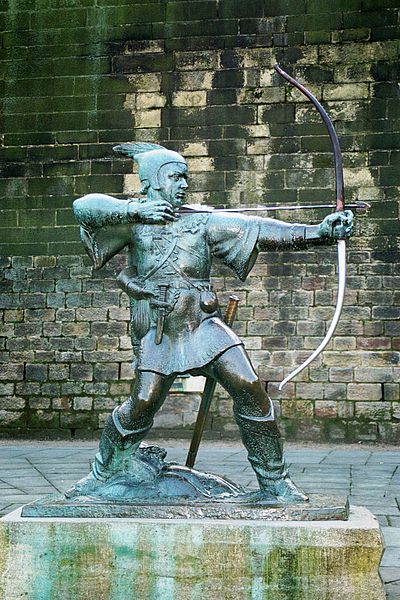
Image: Robin Hood Memorial from Wikimedia Commons. Web Source.

Thursday, April 12, 2018

Week 12 Story: The Righteous King

When Uther Pendragon died, he left no heir to take the crown of Britain.

The knights of the land all fought for his throne, forsaking their people in order to vie for power.

But in secret, Uther had left an heir behind. Arthur Pendragon, who had been spirited away at Uther's behest before his death. He had not wished for his son to be put at risk by power-hungry nobles and knights, instead having Merlin send Arthur to be raised by a good-hearted knight by the name of Ector.

Years passed, and the fights over the throne started to move from those of words to those of violence. In order to prevent blood from being spilled, Merlin summoned all the lords and gentlemen of Britain to London. There, he presented to them a sword, one trapped inside a bar of steel that rested on top of a stone.

"Whoso pulleth out this sword is by right of birth King of England."

These were both the words he spoke to them, and the words inscribed upon the stone.

Many tried to pull the sword, but all failed. Despite these failures, the knights decided that any man had a right to try to win the sword, and held a tournament. Sir Ector came to the tournament, and he brought both of his sons: Kay and Arthur.

Arthur had not been kept unaware of his birthright, and while he was not an ill-hearted boy, there was an arrogance and superiority that this knowledge had caused in him. He did not wish to have power for its own sake, but believed that it was his birthright to guide England. Upon hearing of the sword, Arthur took advantage of the tournament to make his way to the square. All others were at the tournament, and so none were there to stop him from grasping the sword. With all of his strength, Arthur pulled-

-and the sword did not budge. Stunned, Arthur tried once more. And again. And again, and again, until he was red in the face and breathless from exertion.

But the result did not change. The sword in the stone, the proof for whosoever would become king, did not move for Arthur Pendragon.

In a daze, Arthur left to go to his brother Kay.

---------------------------------------------

Later that evening, the sword was still unattended. The tournament was wrapping up nearby, and various people walked through the square, finishing up their tasks for the day and returning home.

A scream came from an alley, and frightful glances went in the direction of its source. However, no one moved to help. They did not have the strength to help, nor the courage.

Except one boy did. Artus, the son of a peasant and with nothing else to his name, knew nothing about fighting. He knew nothing about swords, or kings, or even about knights. But what he did know is that someone needed help, and the only weapon he could see was a sword sheathed in a stone.

Without hesitation, he grasped the handle of the sword and lifted it with ease.

Ignoring the gasps of those around him, Artus dashed to where the scream had come from, coming across a noble's soldier intimidating a farmer.

Without a word, Artus moved between them, aiming the sword inelegantly at the soldier. He knew he could not win, but protected the farmer regardless.

Instead of death, a stunned stare from the soldier greeted him. The soldier recognized the sword Artus held, as his lord had failed to pull it from the stone.

Artus was surprised at this, but even more so when the soldier and the farmer both knelt to him. All the other people of the town, having followed when they saw him rush off, knelt as well.

"Hail, our new king!"


--------------------------

Author's Note:

In the original tale, Arthur Pendragon is the rightful king of Britain. He is unaware of his identity, and pulls the sword from the stone when looking for a replacement sword for Kay's after Kay forgets his sword. While I like the tales of King Arthur, I like the idea that the sword would choose someone based on whether or not they deserve to be king rather than a birthright. Therefore I created Artus, whose personality is that of someone who protects those in need, and changed Arthur to be aware of his birthright, becoming slightly arrogant because of it and intentionally trying to pull the sword and become king.

Bibliography: The Drawing of the Sword from King Arthur: Tales of the Round Table by Andrew Lang. Web Source.

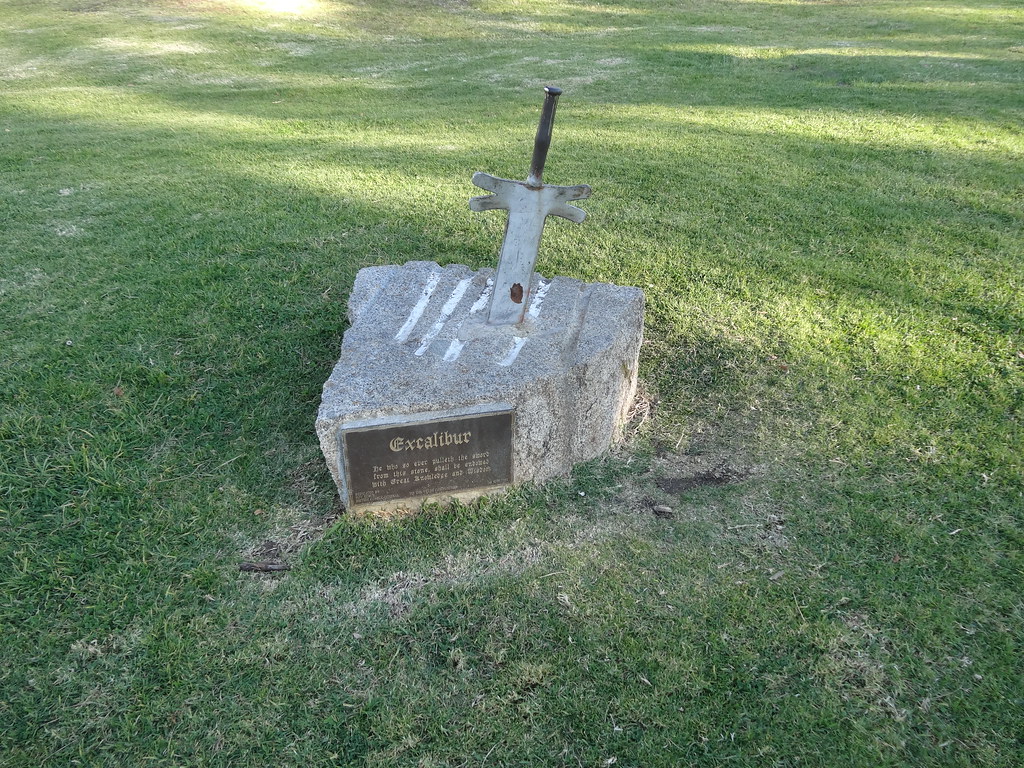
Image: Excalibur Sword in Stone among the Celtic Standing Stones at Glen Innes New England by denisbin on flickr. Web Source.

Wednesday, April 11, 2018

Week 12 Reading B: Sir Lancelot and the Five Hundred Knights

  • Lancelot went through the forest and met hermits after a Knight stole his horse and helm; had an adventure and got them back
  • Learned from a hermit that Galahad was his son, and that Galahad sat in the Siege Perilous at the Feast of Pentecost
    • Siege Perilous was seat at Round Table reserved for the person who would retrieve the Holy Grail, and was said to kill anyone else who would sit in it
  • Sir Lancelot then came to a castle where 500 knights fought
    • Near the castle were knights in black, and the others were knights in white
  • Since the black knights were faring worse, Lancelot joined their side
    • He always takes the side of the weak
  • White knights tired Lancelot out and took him away into the forest
  • Lancelot was shamed by his loss, and was "persuaded that [he was] more sinful than ever [he] was."
  • Rode until he reached a chapel, where a nun inquired as to his name and quest
  • Lancelot answered
  • The nun tells Lancelot that the tournament was symbolic
    • Black knights were unpurged sins while white knights were those of holiness
    • Lancelot went to aid the sinners when they were overcome, which caused his loss
    • Nun warns Lancelot of his "vain-glory" and pride
    • Tells him that "among earthly sinful Knights [he is] without peer."


Bibliography: An Adventure of Sir Lancelot from King Arthur: Tales of the Round Table by Andrew Lang. Web Source.

Image:  Combat de chevaliers dans la campagne by Eugène Delacroix on Wikimedia Commons. Web Source.